Failure Is Not An Option Unless You Make It One

(Click Here) for the podcast version of this article

Okay, I think I’m actually leaving the forest behind me for now, at least for the moment, while we move on to the actual preparation for a podcast. I think we’ve spent enough time in discussion and it is time to consider action. In other words, it’s time to quit talking about it and start doing it.

With all of the neat technology available to us these days, there is absolutely no reason why we can’t turn out a great podcast and have it sound as if we have been doing it for years. Even if you are an absolute beginner, one that has never done even one podcast before, or possibly, never even talked into a microphone at some time or other, you can make a successful podcast and you can do it sooner than later. Why, I would even venture a guess that you can even surprize yourself with the production you can turn out using the tricks, techniques, software and hardware I’ve mentioned here numerous times over the last six months or so.

Now that I have said all of that, let’s not forget that there are still a few important things we need to remember. If you have been along for at least part of the ride we’ve taken so far over the last several months, you know one of my main complaints and objectives has been to not neglect the details. I know you’ve heard people say ‘the devil is in the details’, but I totally disagree. Paying attention to small details can make a big difference between a mediocre and fantastic podcast. There are certain things you need to work on as far as technique goes, and then there is the fact that you need to relax and get comfortable behind the microphone. Let’s talk a little bit about that, now.

I know I’m pretty opinionated when it comes to certain procedures and the resulting final products people turn out, but, and I know I’ve said it before, if something is worth doing I think it is worth doing well. Why in the world would anyone want to waste their time turning out a podcast that is full of poor production techniques and sloppy mistakes that could have been avoided with just a little forethought, practice and preparation. I’ll even borrow line from the ‘audio generator’ folks and say, “If you can talk on the phone” you can make an audio blog, podcast or whatever. All you have to do is talk to the microphone as if you are talking to a friend. I know that sounds too easy, but it is true (at least to get you started) and it could very well be that that concept is what it takes for you to be able to relax and just let your conversation flow. Don’t think of yourself as speaking in front of hundreds of people that you don’t know. Think of it as speaking to someone you’ve known for years and you are very comfortable sharing your thoughts and knowledge with.

Why not write out your script? I know that requires extra effort, but it can make you more effective in delivering your message. I realize there are some of you out there that just like to fly by the seat of your pants. If you can do it, great! However, not many can and even those that can will have at least some form of an outline of what they want to talk about. Listen. There is no shame in having your topics written down in outline form. Doing this can definitely help you stay on track.

You’re the one that makes the choice of what you need as far as this procedure is concerned. I have a friend that makes outlines from his thoughts when he is preparing to speak with one or two words per thought. I have heard him speak and I have seen his notes. I am amazed at how much he can say with so little written down. Myself, I am just the opposite. I like to write out my podcast word for word in article form, but, I am in no way bound to every word it contains. I can, and do , edit on the fly. That means I can add to it, or subtract from it, as I go.

So what does all this mean? It simply means that I have a fairly well organized script to follow that I have taken the time to research and write. That means I feel pretty confident as I talk. It allows me to concentrate on getting my point across and not have to concentrate so hard on what I want to say.

That’s why I say it is well worth taking the time to prepare. If you are doing a solo webcast, I think it is even more important to have that preparation. It makes your presentation flow.

If you have two or more hosts, your job can be quite a bit easier. Talk does come a little easier between two people. Even though I still think it is a good idea to have at least and outline with multiple hosts, it probably isn’t as necessary to have a full script. Usually, the outline gives direction when the flow of ideas reaches a lull.

So, now you need to decide several things if you want to get started successfully with your podcast:

  1. You need to decide what software you want to use. There are many to choose from and some are easier to use than others. I still recommend ‘Audacity’ for several reasons. It is free, it is easy to use and, as if that is not enough, it does a great job.
  2. Make an outline or write a script, once you have decided on a subject.
  3. Practice reading through your script. This will help you become more comfortable when you actually ‘Go Live’ in front of the mic (or audience.) The more you read, (or talk), in front of the mic, the more you learn about how to make your talk interesting and the easier it becomes to sound natural and confident. In general, you learn learn your craft better.
  4. Practice recording with your software program. This will give you the chance to check your levels and be sure you are able to capture your production. (There is nothing worse than finding you have just made something that is unusable and having to do it over.)

If you will take the time to prepare your equipment, your production and yourself, there is very little room for failure. Thus, the title of this article; “Failure is not an option unless you make it one.”

By taking the time to prepare all of the above, you will just about guarantee the success of your production. If you decide to ‘wing it’, there is no guarantee you will fail, but, it could very likely be the result should you choose that option.

See ya next time . . .
Can’t see the forest for the trees . . .

(Click Here) for the podcast version of this article

I can’t tell you why I’m so hung up with this forest stuff at the present. I guess the images in my mind just fit for the moment. Every once-in-a-while, it seems I just have to spout off a little and make my position known and, I guess this is one of those times.

As I look out at the podcast landscape, I see many things available, and yet, so little of what I am looking for. When I do find something I am looking for, I either get excited or disappointed. I get excited when I find someone has actually put a little thought into their production and turned out a decent podcast and, believe me, that happens quite often. The disappointment comes for several reasons, one of them being, either they just don’t get it or I don’t.

Please don’t misunderstand me; there is some really great stuff out there in both the audio and video areas. Many are very professional technically and extremely excellent in production and content. I guess I just get weary sometimes with what some call being creative. (Of course, there is always that inattention to detail thing I harp on a lot.)

Now, admittedly, I am more oriented toward the educational side and less toward the entertainment side, but, both require a few things to be done right for them to be effective, at least in my opinion. These few things have very little to do with the way a person talks, (or looks, if we are talking video), and a lot to do with how they want to be perceived by those that will be listening or watching. It has to do with making a production that is worth seeing or listening to. It has to do with choosing the right equipment and software; maybe even in choosing the right format to get their point across to their audience in the most effective way.

I am not criticizing, nor minimizing, a person’s ability or freedom to be creative. I just think there is more than enough junk out there that keeps people from seeing the beauty of the forest. Some podcasts are nothing more than trees and have nothing at all to do with the forest because they don’t fit. The vision for them is so limited, they really ‘can’t see the forest for the trees.’ I know podcasting is still in it’s infancy, but some don’t understand they are helping lay the groundwork for the future of the industry as a whole and what peoples’ impression of it will be.

Another of the main reasons I get disappointed is poor production techniques that could easily be improved upon with a little bit more of ‘paying attention to detail’. I guess one thing I notice the most these days is how disinterested some people are in doing a good job. It seems to me they think it is cool to just get their podcast on the net and shock people with their new found freedom. They don’t have much to say and what they do say is filled with with lots of coarse language and very little content. Mostly, this type will fade pretty quickly, but it makes me wonder what their original vision was.

And then there are those that could do one or two things differently and have a much better production. I know I am a bit picky when it comes to certain things, but, things like room ambience and echos distract me. I know those little detail things don’t bother some at all, but I know I am not alone when it comes to being distracted by them.

Now bear with me for a few moments while I ride out this rant I’m on. I know that you, as a beginner podcaster, can do better than others. You’re taking the time to do a little research and planning. You have something to say and it needs to be said. Go ahead … the microphone is yours … make your point, show you’re creativity, get those laughs or enter into the land of “oohs and aahs”. But don’t forget to pay attention to those little things that can make your good podcast, great!

Hey, I like to laugh as much as anyone and I can be moved to tears without embarrassment when the message is right. Just show me that you can do it without taking the easy way out. Show me you’re creative enough to make your point, and make it well, without all of the cheap shots. And while you’re at it, do it without taking the short cuts. Take the time it takes to do it right! Taking that time doesn’t always mean hours … it could just be minutes or seconds that can make a positive difference.

In the same way that people can’t see the forest for the trees, many can’t see the value in putting forth a little more effort to create a better podcast and therefore making it more successful. There is more to it than just getting it out. Make it good … make it happen … look at the big picture. See the forest … not just the trees.

See ya next time . . .

Why Is Podcasting Sometimes Like A Tree Falling In The Forest???

(Click Here) for the podcast version of this article

There is an old saying people use and it goes something like this: If a tree falls in the forest, does it make any sound if no one is there to hear it?”

That’s a good question even if it does sound a little dumb. If the falling tree does make a sound and no one is there to hear it does it make any difference whether it happened at all? Will anyone even know or care that it happened?

I think we all know the sound is there, it just takes someone to be there to experience it to be sure of the fact, or at least, share the experience with others so they will know that it happened.

I think that’s the way it is with podcasting also. There are many existing and brand new podcasts being put out every minute of everyday. Some are heard and some are out there just waiting to be heard. Some are great, some are good and other’s … well … they’re there, but … who knows why? (Sorry, sometimes those editorial comments just kinda slip out.)

If the sites and sounds are there but no one is there to see or hear them, that’s as if they aren’t there at all, isn’t it? No one knows about them. No matter how good or bad they may be, without an audience, they are just background noise that is ignored and goes completely unnoticed. To a beginner, that can be somewhat discouraging. To an advanced user, it is a challenge. The challenge to both being how to get someone, or many someones, to hear and see the sites and sounds and share the experience with others.

Now, I don’t want to go into a big discussion on how to get or grow an audience at this point, but I will say this. The better the quality of the material and the way it is presented, the better chance it has of being recognized in a positive way and becoming a successful venture.

Why would anyone care if their podcast is successful or not? Isn’t it enough that they produce it and it is there for someone to listen to?

You don’t have to look very far to see the answer to the first question. Podcasting, whether audio or video, is becoming one of the most important means of communicating ideas between people. Some are there just to make us laugh and some are there to help us understand what is going on in the world around us. Even others are there to inform us of our favorite past-time, hobby or interest, or, educate us in any number of subjects. If someone produces one and no one knows it exists, the information is sitting there with no audience and no hope of becoming effective or successful in any way. So, simply producing one doesn’t mean that the information it contains will ever be heard or seen.

It is important to remember the reason why you want to produce yours if you want to see your audience grow. What is the reason you wanted to do one in the first place? Was it to communicate an idea or raise the awareness of some injustice or concern? Was it to make people laugh at certain situations, or, themselves? Perhaps you wanted to generate an income, or help others generate one, and you use the medium to sell the products, share the information and the process. Whatever the reason, there must have been something about it you thought was important enough to spend time in producing it.

At some time or other, you will want to be sure that the message you have for others is going to be heard. There are ways to accomplish this and we will discuss them along the way over the next few weeks. In the mean time, just remember the reason a podcast can sometimes be like a tree falling in the forest is because no one is there to hear it.

See ya next time . . .

What To Do In Case Of Being Uninspired…

(Click Here) for the podcast version of this article

It happens to us all at some time or other. You just flat run out of things to talk about with your podcast, or, at least you think you do. You struggle and strain your brain, trying to come up with something worth talking about, but it seems the harder you try the more blank your mind goes. No matter what you come up with, nothing seems to germinate into an idea worth spending any amount of time on.

So, what do you do . . . ?

You begin to write. That’s right, you take the first things that come to mind and do your darndest to expound on them. You work at them until one of them catches fire within you and you begin to notice that it has captured your interest. After that, the rest is following the flow. Yes, you heard me, “you follow the flow.”

So, what does that mean? It means, you have just forced your way through a bout with ‘podcaster block’ and the creative juices begin to flow once again.

Sometimes, it takes forcing yourself to think about subjects you want to talk about, write them down and then, after you have some fresh ideas before you, your mind begins to work on those ideas. Somewhere along the way, your mind takes the hint that you aren’t going to stop bothering it until you have something to focus on so it begins letting the ideas flow. (At least that’s one way of looking at it.)

If that sounds strange, maybe you haven’t actually experienced it yet. But don’t worry, you will. “Writer’s block”, “podcasters block”, or whatever you want to call it, does happen and it happens to everyone, (somewhere in their journey through this life).

When I run across those times that I just don’t have the ideas readily available, here’s what I do.

  1. I take the time to write down some titles of some subjects I want to talk about.
  2. After I have written down a few, I go back and begin writing a sentence or two to remind me of the specifics I want to talk about.
  3. After I have written down those ideas, I walk away from them for a period of time. That’s right, I walk away from them and let them gel a bit.
  4. Either a few minutes, or possibly even a day or so later, I go back and read over them again.
  5. I take the one that captures my attention and begin to write more about it. If it doesn’t begin to flow, I save it and go back and grab another one and do the same.

As I continue reading and writing on them, I find I have several good ideas, and possibly, even a few finished articles. Then I go do the same thing all over again. Usually, I find I have enough to keep me busy for a while. Some of them even get combined together to become one article.

If all of the above things don’t seem to work, I go check out a few of the sites I like to frequent and see what they are talking about. In doing this, I hope to get inspired by an idea or two, or, at least a new angle on an old idea to discuss. With all of the available information out there, I know there just has to be something I haven’t been able to think of and it helps to get other people’s input and viewpoint. Their input may or may not be exactly what you want to talk about, but, it could quite possibly be something that inspires you in a whole new direction and gives you an abundance of things to talk, or write, about.

See ya next time . . .

You Can Do This

(Click Here) for the podcast version of this article

I’m sure you already realize this, but, podcasting can really be a lot of fun. If it isn’t going to be fun, then you might as well hang it up right now, before you get started. If it becomes a drugery to you, you won’t make it for long because there are going to be days that you just won’t ‘feel’ like doing it. Once that “feeling” settles in, it gets harder and harder to make it happen. When that happens, you no longer look forward to doing your podcasts or any of the preparation it might take to ‘get ‘er done’ and it’s for sure, you won’t want to take the time it takes to do it right.

Let’s take a look at some of the things we’ve been talking about over the last several weeks. We’ve talked about things to do, and think about, to get a good start in podcasting.

In doing that, we’ve talked about several things I think are important:

  • First and foremost, don’t be too proud to get input from others that are already successful at podcasting
  • Check out other sites for their information and possible affiliations, etc
  • Decide which equipment you want to use (Its okay to start cheap if you want)
  • Decide what software you want to use. (Will you use free software or will you pay for it?)
  • What is your focus going to be? (What is the subject, or subjects, of your podcast going to be?)
  • What length format you will use? (will it be minutes or hours?)
  • Who will host your podcast? (Free hosting or pay hosting?)
  • How often will you be creating a podcast? (Once a day, week or month?)
  • Who is your main audience going to be (Do you know who you are trying to reach?)
  • Have a long term and short term plan for your podcast (Planning helps insure your success)

I’ve spent a lot of time trying to give the beginner podcasters an edge over others who are unwilling to listen to voices of experience. Do I think I know all there is to know simply because I have been doing it for a while? Of course not! I talk a lot about technique, paying attention to details and numerous other things because I think they are necessary for turning out a good product.

I think it is important to do all of those ‘things’, but always remember this. I am, in no way, trying to discourage anyone from pursuing their dreams or trying to mold them in a certain way so that they can fit into the mainstream of the ‘status quo’. I just want all of you to be the very best you can be and think further down the road than one audio or video podcast. This is not because I want you to be like me. I simply want you to understand that there are many people that have knowledge of podcasting and recording and editing. You can cut down your learning curve by taking some time to listen to their input and see if what they know will help you accomplish what you want. None of us are trying to remake you into something other than who you are. We just don’t want you to make the same mistakes we did. (Perhaps it was in those days when we thought we knew it all.)

There are so many reasons why it is necessary to learn as much as you can about properly recording and editing audio and video for podcasting and other purposes. A very important one is that it is becoming increasingly evident that the internet is becoming a place where more and more people are visiting first to check out differing products and desired information. It is still a blossoming industry and all of its potential is still being recognized. Why not be a leader in it instead of an ‘also ran’?

You see, I believe that everyone is endowed with certain characteristics and talents that are theirs to pursue and build on. I really like the creativity expressed by those that have turned out some very interesting videos and some really great audio podcasts. Some of us wish we had your talents and I personally call upon you to continue expressing your creative pursuits. That’s what is so great about podcasting. You are relatively free to present your ideas in your own creative ways and get the message to hundreds of thousands easily and relatively cheaply.

Now that you are ready to really begin your podcasting adventure, I only have one short statement to make as you move on to getting started. YOU CAN DO THIS!

See ya next time . . .

To Get Started Right … The Choice Is Up To You

(Click Here) for the podcast version of this article

Life is full of choices and entering into the podcasting life is no different. Have you really thought about who you want to reach and what you want to accomplish with your podcasts? There is nothing wrong with beginning with a single idea and trying it out, but you also need an expanding vision of the possibilities. Along the way, you may find your focus and direction change a little –maybe even a lot– but it becomes more clear.

If I may, I want to speak to you from my personal experience on this subject. When I first started with my pursuit of podcasting, I had an idea of what I wanted to do and I had a lot I wanted to say. I wanted to share the things I have learned over a lot of years of working with live and studio sound. I have also spent a lot of time during those years recording groups and individuals, capturing them live. Most of what I have done in the recent past can be edited later, but I only get one chance to capture it. Many of the things I have done, and do, are for broadcast, both live and captured live and edited for later broadcast.

I learned a long time ago, whether recording or podcasting, the more your do it, the less you find you know. Don’t misunderstand what I am saying. I’m not saying that experience and knowlege don’t mean that much, but, the more you learn the more you know there is to learn. I have always been a person willing to share what I know if someone is willing to listen. Still, everyday is a learning experience for me. I don’t know everything there is to know, but I am thankful that there are others that are willing to share their knowledge with me. Technology is changing at such an abrupt pace that it is difficult to keep up with everything.

The more I’ve done, the more I have changed my approach, but not necessarily my direction. I haven’t departed a long way from my original vision but, over time, I have expanded and honed it to take in more things that I, at first, thought I didn’t want to do. I have begun to focus more on a method to teach what I have learned and know. What you choose to do with my knowledge is up to you. I simply share what I know and have learned an hope that it helps one, or many of you, advance toward your goals for podcasting and that you can avoid at least some of the pitfalls.

Now, getting back to you and your podcasting; do you want to take the idea you have and make it an everday thing or once a week? How about once a month? We can talk about those options more fully later, but they are options that must be considered very early on.

You have to choose how you want to get to where you want to go. If you think you can just get on the mic and start talking, you will find your dream may be short-lived. Understand, your short sightedness may work well if you are the only one listening to your production, but, if you want to grow your audience, you need to have a strategic plan for your podcast.

In the end, the choice is up to you. You choose what you want to say and how you want to say it. You even choose whether you want to take ‘the time it takes to do it right’ or just throw it all together and hope for the best. You see, ‘flash in the pan’ podcasts, whether audio or video, can be wonderful for the moment, but they seldom last any length of time. Your choices will affect the way your podcasts will be looked at and thought about by those that frequent them. Choosing to plan, whether short term, long term or both, is the best way to better assure yourself of extended success.

See ya next time . . .

When It Comes To Podcast Quality, Equipment CAN Make It Happen

(Click Here) for the podcast version of this article

You’ve probably already noticed, but there is something different about the podcasts I do now. But, before I talk too much about that, I’d like to talk about another difference in what I am now doing and that is, the direction I want to take as we journey forward together in the near future.

Over the last few months, I’ve spent a lot of time talking about ways for beginners to get started in podcasting without making a large financial investment –(refer to Starting a Podcast ‘On the Cheap’)– and I still believe you can do that. If you don’t remember too much about those articles you can check them out, but, let me give you a quick overview refresher of at least one of those articles.

I have mentioned several ‘On the Cheap’ start up softwares and equipment many times in the past. If you remember, one of the most important and inexpensive things we talked about was the software program, ‘Audacity’. If you spend much time researching podcasting in general, you will find many people talk about this free recording/editing program in their books and podcasts. There is a reason why that happens. It is because it works and works well. I tend to use it most of the time for editing my podcasts because it is quite easy to use and because I am already familiar with it.

There are a few programs out there that do more than ‘Audacity’, but if you’re just beginning, or even if you’ve been around a while, you will find it does a great job. It is very easy to use and to get started with as well as being cost free. In a very short period of time, you soon find it is easy to move on to use some of the more sophisticated options it offers. In fact, I plan to spend a little time talking more about the use of ‘Audacity’ in the very near future.

You see, I like a program that allows me to get started quickly with the basics and then easily allows me to work my way into the options necessary to make my recordings, and edits of those recordings, better. This is the way it is with ‘Audacity’. Oh sure, I know there are some other programs out there that are great programs but, in my opinion, some of them are not as easy to get started with. They seem to be a bit too sophisticated and require too much ‘reading of the manual’, often causing a more than a bit of frustration, just to get started. This only leads to early termination of peoples’ productions because, it is just too hard to get started. (Personally, I like easy and I know I am not alone in that consideration. Easy is good.)

Also in those earlier articles, I often mentioned how easy it is to use some simple equipment you probably already own. Whether it was a small, hand held digital voice recorder or a good sounding headset mic, I still firmly believe you can turn out a ‘decent’ recording with relatively inexpensive equipment. The important thing about the recordings you make is the quality that your equipment can capture and reproduce. If you don’t have a relatively clean and good sounding master recording, it is a pretty good bet your final product is going to have poor quality sound also.

So, where is all this leading? I have added a new piece of equipment to my toolbag and I just love it. I think it has added yet another bit of quality to my recordings and podcasts. (I’ve also done a few other things I will discuss in the future.)

I finally decided to step up and try one of the portable, handheld devices for capturing audio and making it quite easy to load into my computer. The one I decided to buy was the H-4 by the Zoom corporation. I’ve been using it for about three weeks and I am quite pleased with the quality it turns out. I have to admit, it took about an hour or so to get comfortable with how it worked with its menus and things, but, I was able to get started with it relatively quickly. I’m still learning how to use all of its capabilities but haven’t mastered all of them yet and I’m not trying to learn it all in one day. I just take it one step at a time.

This little unit can do a lot. I list some of its features here:

  • 2 track mode for stereo recording
  • 4 track mode for multi-track recording
  • Built in X/Y pattern stereo microphones
  • High Z inputs for guitar and bass
  • MP3 recording up to 320kbps
  • WAV recording up to 24bit/96kHz
  • USB audio and mass-storage interfaces
  • XLR inputs with phantom power
  • Up to 2GB SD card memory capable
  • Can be hand-held or tripod mounted for versatile ease of use

Believe me when I tell you, it can do a lot of things and I have only scratched the surface of its capabilites, but the thing I like about it is the quality of the recording it can turn out. I can record and save it as an MP3 file or a WAV file. This makes it great for quick loading into ‘Audacity’ for editing because ‘Audacity’ directly accepts both of those files. It can also be used as an interface for direct recording to the computer.

I made the choice to step up my equipment and thought long and hard about just how I wanted to invest my money. This seemed to give me the most versatility and portability for the price. I like the part about it being portable and able to set it up quick in any situation I choose. I will tell you more about the progress in the coming weeks. So far, it is wonderful.

See ya next time . . .

(Podcasting Quick Tip #3) Try this . . .

A short while ago, I talked about using a digital voice recorder to record something and then load it into your computer later using audacity to edit it. (That was in podcasting quick tip #1 if you would like to check it out.)

This one is for beginners and advanced users alike. It is either good in a pinch or as a quick way of having a backup for a phone interview. It could possibly even help with a quick live interview that you weren’t really prepared for or one that happens on the spur of the moment.

Now remember, this isn’t being captured in your studio, so it won’t be perfect, but, it will turn out remarkably well. You can enter it directly into your computer and use your digital voice recorder as a hand held microphone. On thing I really like about this is it allows a better quality input because you are entering it directly into your computer as if you had a hand-held microphone. It also leaves you with a backup copy on your digital voice recorder just in case something goes wrong with the computer copy.

Once again I am using an OLYMPUS digital voice recorder,WS320M. I really like the way it records, (I use it in HQ record mode). It is a 1G voice recorder and mp3 player. It also has a USB direct connect input for your computer. (This makes it quick and easy to enter into your computer, later, should you need to.) To Try This . . . you will need:

  • The Olympus digital Voice recorder (or a good substitute)
  • An 1/8 inch (at both ends) stereo cable (preferably a minimum 6 feet long)
  • Your laptop(or desktop computer)
  • Audacity software

The other thing I like about this is that it is really simple. You will have fun with this. You can even use this as a way of getting a quick start for your podcast.

(For starters, be sure to turn down your speaker volume control to eliminate possible feedback while you are trying to record. Audacity has settings for being able to listen to what you are recording. Let’s keep it simple and have fun. There’s plenty of time to confuse ourselves, later.) Here’s how to do this:

  1. Plug one end of the 1/8 inch stereo plug into the earphone jack of the Olympus.
  2. Plug the other end into the Mic input of your laptop
  3. Open Audacity and set it for Mic input. (Click here if you don’t have Audacity)
  4. Press record on the audacity program
  5. Press record on the Digital Voice Recorder
  6. Run a test recording of the input to set your levels
  7. Press “control Z” to erase the the test recording (for the computer)
  8. Press stop button on digital voice recorder (manually erase)
  9. Repeat steps 4 and 5
  10. Start talking and watch the magic happen.
  11. When done stop both recordings and you are ready to edit and upload or store.

That’s easy, huh? With practice, you will be very pleased with the end results.
Just a couple more things you will need if you want to use it for recording a telephone interview. You will need a tape recorder to telephone adapter for recording you and your interviewee from the telephone. (I got one at Radio Shack. There are other places to get them.) You may not need this next item but it is nice to have and it makes everything work much better. An 1/8 inch monoral/stereo adapter for adapting the telephone adapter to stereo input. This can help eliminate problems with noise, hums etc.

See Ya Next Time . . .

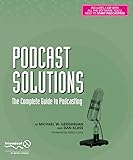
“Podcast Solutions”by Michael Geoghegan and Dan Klass … This Months Book Review/Recommendation

Podcast Solutions: The Complete Guide to Podcasting (Solutions)(click on the pix to get it quick!)

This is my recommendation for the book to read for the month of February if you are a beginner looking to get started, or simply like would like some great info for making or improving your podcast.

I realize there are a lot of books on the market for podcast beginners and advanced users. I think this book is well worth the investment whether you are a beginner or an old pro, (maybe even a young, old pro). Because there is so much in this great book I just want to tell you a little of what it contains. Now, that doesn’t mean I won’t be metioning more about it later, it just means I want to tell you a few things about it at this time and hope you will pick it up as a valuable resource you will be able to refer to on a regular basis. These guys KNOW what they’re talking about.

From the pages of this book you will harvest a wealth of information on things like:

  • How to use “podcatchers” like iTunes, iPodder Lemon, and iPodderX
  • Secrets of creating the perfect podcast
  • Expert advice on how to design a successful show
  • How to set up an effective studio in which to record your podcast
  • Includes the complete “Podcast Studio Buyer’s Guide”.
  • Everything you need to know about recording, editing and encoding
  • Everything you need to know about uploading your podcast
  • Information on using music “legally”
  • Attracting sponsors, advertisers and other evenue sources for making money with your podcast

Michael Geoghegan and Dan Klass are pioneers in podcasting. (You can find out more about them by clicking the links in “Podcasting Quick Tips #2” This book a not just something you will want to have for one read. It is something you will want to refer to often even though podcasting is a technology that is changing rapidly. This book is jam-packed with great information and I like the way they offer the important information and yet keep it simple and straightforward. They present it in an understandable way and that is a BIG plus for those that pick it up to get a great headstart on podcasting even though they may be absolutely new to the technology.

Now here’s another thing about this book I really like. It comes with a CD, (worth the price of the book by itself), packed with useful programs, although mostly trial versions, for getting started in podcasting. Even though some of the programs are trial versions they will give you a good feel for the programs BEFORE you invest your hard earned money and that can help you get started on a shoestring and move up as you progress or start up without having to go at the programs ‘cold’.

All in all, I guess you can tell I like the book. I would rate it at least four and a half stars.

See Ya Next Time . . .